


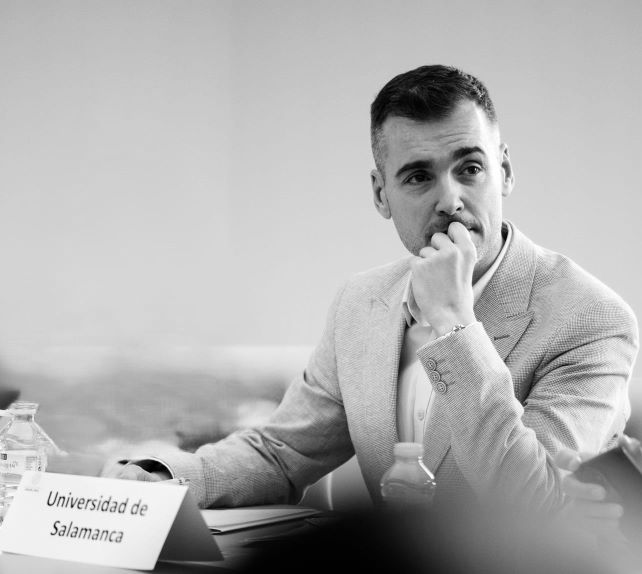
Pedro Álvarez Mosquera teaches English and Linguistics in the Department of English Studies at the University of Salamanca. His main research areas include sociolinguistics, cognitive linguistics, psycholinguistics, and linguistic landscape, among other interrelated areas. Currently, much of his research focuses on the role of language and language attitudes in the process of social categorization and intergroup perception in South Africa as well as other contexts of language contact situated in both the Global South and the Global North. In this area, his emerging research focuses on language and migration.
Throughout his academic career, he has collaborated with various African universities in South Africa, Mozambique or Senegal, and, more recently, in India – among other countries. Since 2022, he has been the Coordinator of the African Languages Day/ Forum of African Languages, Cultures and Societies at the University of Salamanca, one of the most iconic outcomes of the ERASMUS + BAQONDE’s legacy in Europe. Pedro Álvarez has been a UNISA Research Fellow (South Africa) since 2017. In 2024, he was appointed as an NWU Extraordinary Professor in the Area of Research “Understanding and Processing Language in Complex Settings” (South Africa), and he belongs to the Spain-India Council Foundation.
TEAM

María Carmen Fernández Juncal (Catedrática de Universidad)
Academic and research profile
C.V.
Carmen Fernández Juncal holds a PhD in Spanish Philology and is a Full Professor of General Linguistics in the Department of Spanish Language at the University of Salamanca. She has been Vice-Rector for Teaching at the University of Salamanca, Vice-Dean for Academic Programmes and Teaching Quality, Vice-Dean forTeaching at the Faculty of Philology, and Director of the master’s degree in “Teaching of Spanish as a Foreign Language,” as well as Director of the International Spanish Centre at the University of Salamanca.
Actualmente es directora del Máster en Investigación Lingüística y del título propio Escritura Académica para Investigadores.
Her research focuses on several areas related to sociolinguistics: variation in the Spanish language, socionomastics, linguistic landscape, and language policies in multilingual situations. She has also devoted part of her research to applying sociolinguistic theory to the teaching of Spanish as a foreign language (‘ELE’ for its initials in Spanish).
She holds five research and knowledge transfer sexenios (six-year periods) and has received the María de Maeztu Award for Scientific Excellence.

Susana Azpiazu Torres (Catedrática de Universidad)
Academic and research profile
C.V.
Full Professor in the Department of Spanish Language at the University of Salamanca. She holds a degree in Hispanic and German Philology and a PhD from the same university. In addition to Salamanca, she has taught at the University of Extremadura, the Albert-Ludvigs Universität Freiburg in Germany, and the Institute of Romance Philology at the Free University of Berlin. Her research has focused mainly on two areas: the contrastive study of nominalisation strategies and ‘language style’ from a contrastive perspective, and temporality in Spanish and other Romance languages, with special attention to the variation between the simple past tense and the compound past tense, the simple future tense and the periphrastic future tense, as well as the modalising uses of certain forms. She has led several projects on this topic and published numerous works, including La composicionalidad temporal del perfecto compuesto en español (De Gruyter 2019). She is currently co-directing a research project funded by the Regional Government of Castilla y León on textual complexity, readability and its application to AI and language teaching.
Since February 2023, she has been director of the International Spanish Centre at the University of Salamanca (https://cie.usal.es), where she has launched and directed various training programmes for Spanish teachers in India (DELHI, teacher training courses in Salamanca), as well as programmes for the creation of materials for Spanish as a specialised language. She is a member of the Spain-India Foundation as part of the University of Salamanca’s team.
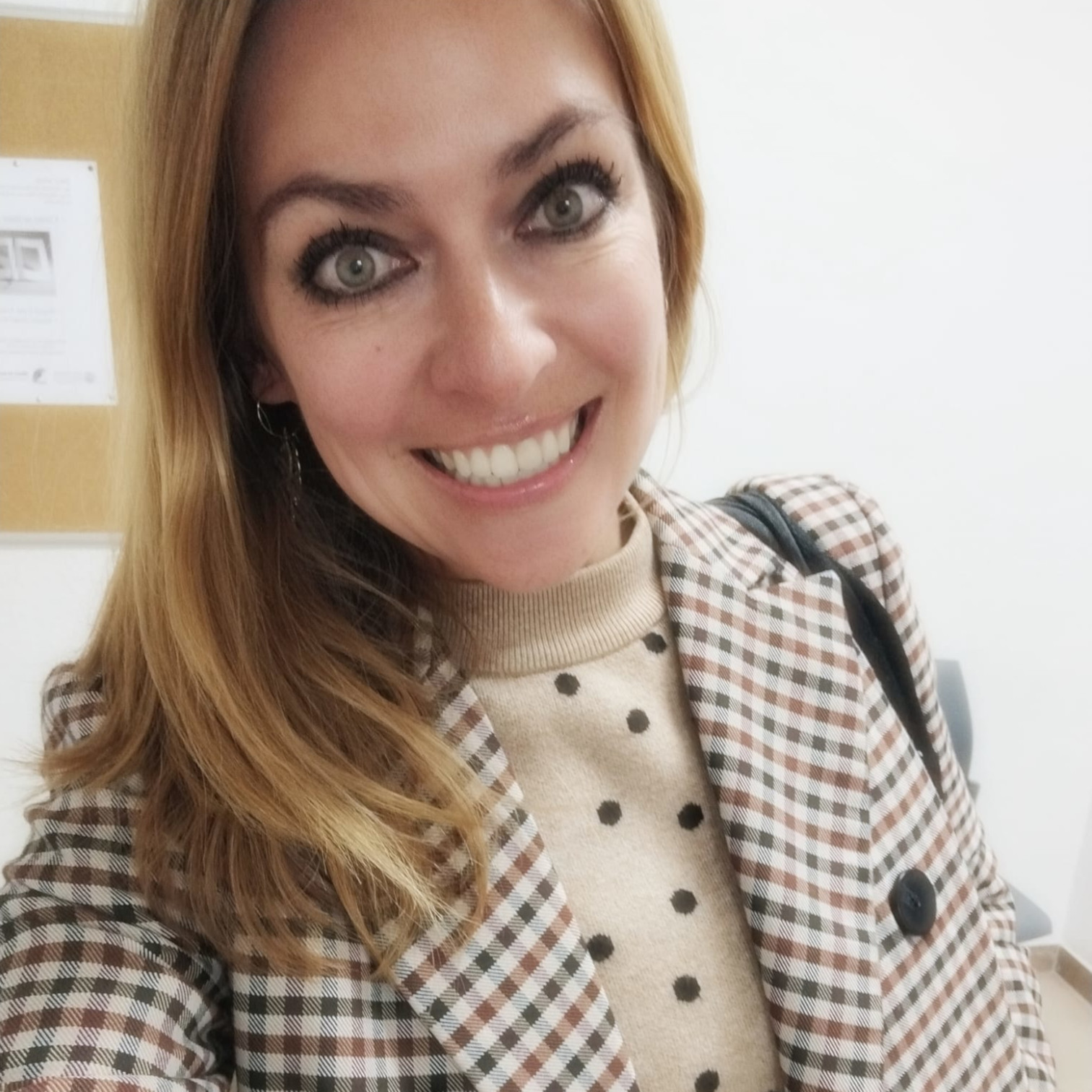
Olga Ivanova (Profesora Titular de Universidad)
Academic and research profile
C.V.
Olga Ivanova holds a PhD in Hispanic Philology from the University of Salamanca and a master’s degree in Hearing and Language Neuroscience from the Institute of Neurosciences of Castile and León and the same university.
She is a Professor of General Linguistics at the University of Salamanca and a member of several research groups: she is a member of the UIC and the LingAP GIR, within which she directs the working group of LendeLab: Language and Neurodegeneration. She is also a member of the Neurophysiology, Cognition and Behaviour GIR at the Institute of Neurosciences of Castile and León.
Her main lines of research are the study of language disorders in ageing, clinical sociolinguistics, and multilingualism from a cognitive perspective, aspects she addresses in collaboration with several institutions in South Africa within the framework of the MultiAging project.

Carmen Sumillera Iglesias (FPU – Colaboradora)
Academic and research profile
C.V.
Carmen Sumillera-Iglesias is a FPU predoctoral research fellow at the Department of English Philology of the University of Salamanca. Her research project focuses on South African language policy in the higher education context, with particular emphasis on historically Afrikaans universities. Her interest in the development of Global South and Global North synergies characterise her PhD dissertation’s perspective.
PARTNER INSTITUTIONS


ADVISORY BOARD

Prof. Rajend Mesthrie
Academic and research profile
C.V.
Prof. Mesthrie’s work covers the sociolinguistics of language contact globally, but with especial reference to South Africa and India. His early work was on the history of indenture and migration of Bhojpuri and Hindi speakers (among others) to South Africa in the 19th and 20th C. He also documented the subsequent rise of Indian English in plantations and classrooms and the role of the pidgin Fanakalo as a plantation and colonial language.
More recently, he has documented, in collaboration with scholars from India, the dialects of Gujarati and Kokni in Cape Town. He has published on the sociolinguistics of contact between English and isiXhosa, isiZulu and siSwati together with senior graduate students and is credited with a unified account of Tsotsitaal varieties of urban youth. He is internationally known for other work on sociolinguistics and English studies generally.

Prof. Justo Bolekia
Academic and research profile
C.V.
Prof. Just Bolekia holds a PhD from both the Complutense University of Madrid and the University of Salamanca, where he also served as a Full Professor. A specialist in the Bubi language —the native language of Bioko Island, Equatorial Guinea—, he has conducted extensive research and authored several works, including grammars and dictionaries, dedicated to its study and preservation. He is a member of the Regional Advisory Committee (Europe) of The Global Council for Anthropological Linguistics (GLOCAL) at SOAS, University of London (UK). In addition, he serves as Honorary President of the Hispano-Lusophone Institute of Libreville (Gabon) and as Vice-President of the Global Harmony Association–Africa (GHA-Africa/CEO).
Dr. Mahendra Kumar Mishra
Academic and research profile
C.V.
Dr. Mahendra Kumar Mishra is a distinguished linguist, folklorist, and educationist with extensive experience in multilingual education and cultural studies. He has played a key role in developing multilingual education policies in India and internationally, working with institutions such as UNESCO, NCERT, and Sahitya Akademi, New Delhi. He received UNESCO’s First International Mother Language Award in 2023.

Dr. Anna Marie Diagne
Academic and research profile
C.V.
Anna Marie Diagne is a linguist and researcher at the Laboratory of Linguistics, IFAN Cheikh Anta Diop, University of Dakar, where she also serves as Head of the Department of Languages and Civilizations. Her research focuses on the grammar and dialectology of Mande languages, with a particular emphasis on Soninke. She is actively engaged in the documentation and grammatical description of endangered languages, including Seereer Paloor (an Atlantic minority language of Senegal) and Sillanka (a Mande linguistic isolate of Burkina Faso). Her current work encompasses the documentation of Senegalese sign languages and the linguistic treatment and preservation of historical sound archives held at IFAN.

